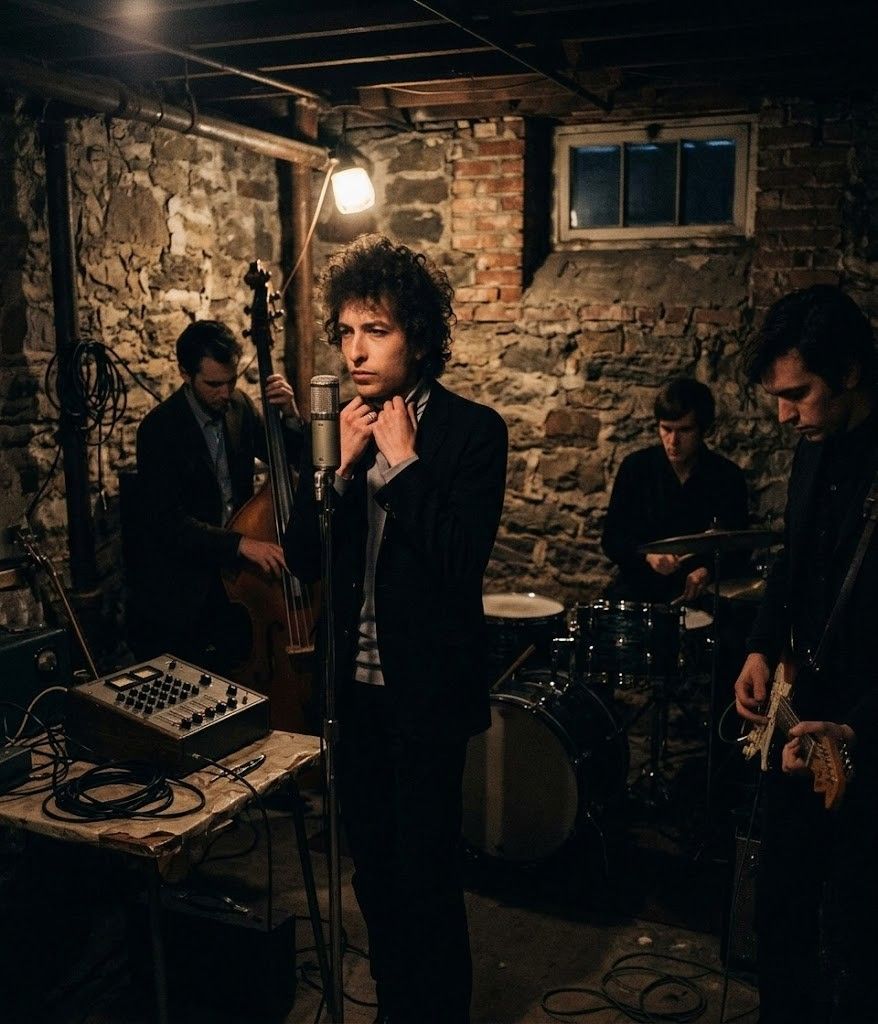
ROCK HISTORY MYSTERY: The Secret Bob Dylan Basement Recordings That Disappeared Into Legend And Changed Music Forever
In the summer of 1966, the world surrounding Bob Dylan seemed to come to a sudden and mysterious halt. At the height of his fame, Dylan had become one of the most influential and controversial artists in modern music. His electrified performances had already divided audiences, challenged traditional folk culture, and transformed the sound of rock music forever. Everywhere he went, attention followed him. Concert halls overflowed with admirers and critics alike, all trying to understand the restless artist who refused to remain predictable.
Then, without warning, everything changed.
News spread rapidly after Dylan was reportedly involved in a serious motorcycle crash near Woodstock. Details surrounding the accident remained unclear, adding even more mystery to the situation. Some reports suggested his injuries were severe, while others questioned exactly what had happened that day. Regardless of the truth, one fact became undeniable almost immediately: Bob Dylan vanished from public life.
For fans and journalists, the silence felt almost unbelievable.
At a time when Dylan dominated headlines and influenced cultural conversations across America, he suddenly withdrew from touring, public appearances, and much of the chaotic celebrity world surrounding him. Rumors spread endlessly. Some believed he wanted to escape exhaustion caused by relentless fame. Others suspected the accident had deeply affected him emotionally and physically. The mystery only intensified as months passed with little public explanation.
Yet behind the scenes, something extraordinary was quietly taking place.
Hidden away in the peaceful surroundings of Woodstock, Dylan began spending time with a group of musicians who would later become known as The Band. Far removed from screaming crowds and media pressure, they gathered inside a modest basement space to record music in a completely different way from the polished studio productions dominating popular radio at the time.
What emerged from those sessions would eventually become one of the most fascinating legends in rock history.
The recordings sounded nothing like the carefully produced albums audiences expected from major artists. Instead, the music felt raw, loose, intimate, and deeply unpredictable. Songs drifted between folk, country, blues, gospel, and early rock influences with an almost spontaneous energy. Mistakes remained in the recordings. Conversations could sometimes be heard in the background. The atmosphere sounded relaxed, experimental, and strangely alive.
Most importantly, these sessions were never originally intended for public release.
There were no grand promotional campaigns. No carefully organized studio schedules. No pressure to create commercial hits. Dylan and the musicians simply explored ideas freely, recording haunting lyrics, unusual melodies, and improvised performances that often felt more like private conversations than professional productions.
The lyrics themselves added to the growing fascination.
Many of the songs carried surreal imagery, emotional uncertainty, humor, loneliness, and strange storytelling unlike anything dominating mainstream music during the late 1960s. Some tracks sounded playful and chaotic. Others felt deeply reflective and almost ghostly. Together, the recordings created an atmosphere that listeners later described as mysterious, hypnotic, and emotionally haunting.
But perhaps the most remarkable part of the story came afterward.
Although the tapes were meant to remain private, secret copies somehow began circulating through underground music circles. No one seemed entirely certain how the recordings escaped into the outside world. Yet over time, duplicated versions quietly passed between collectors, musicians, and devoted fans who became obsessed with the hidden material.
Long before the internet existed, these mysterious recordings developed an almost mythical reputation.
People spoke about them in whispers, describing songs that sounded unfinished yet brilliant at the same time. Poor sound quality only added to the fascination. The rough recordings felt authentic in a way polished commercial albums often did not. Listeners believed they were hearing something deeply personal — music created without industry interference or public expectation.
As copies spread further, the influence of the recordings became enormous.
Young musicians throughout the late 1960s and early 1970s found inspiration in the relaxed and emotionally honest atmosphere of the sessions. At a time when popular music was becoming increasingly elaborate and heavily produced, Dylan’s basement recordings reminded artists that powerful music could also be simple, imperfect, and spontaneous.
Many future rock performers began embracing stripped-down songwriting, roots-inspired sounds, and more intimate recording styles because of the impact these tapes created behind the scenes. The sessions helped inspire entire movements within folk-rock, country-rock, and alternative music for decades afterward.
Ironically, the recordings gained legendary status precisely because they were never designed for commercial success.
Their mysterious origins transformed them into one of the most famous bootleg collections in music history. Fans searched desperately for rare copies while critics debated the artistic meaning behind the material. The secrecy surrounding the tapes only deepened their cultural power.
When portions of the recordings were eventually released officially years later, many listeners were shocked by how influential they already felt. What once existed as hidden basement experiments had become essential chapters in the history of modern music.
Even today, the mystery surrounding those sessions continues to fascinate music lovers around the world.
Some see the recordings as evidence of Dylan escaping the pressures of fame to rediscover artistic freedom. Others believe the basement sessions captured a rare moment where creativity existed completely outside commercial expectations. Whatever interpretation people choose, the recordings remain powerful because they sound deeply human — unfinished, unpredictable, emotional, and alive.
More than half a century later, the story still carries an almost mythical quality.
A legendary musician disappeared after a shocking accident. Hidden away in a quiet basement in Woodstock, he created strange and deeply personal recordings with friends, never expecting the outside world to hear them. Yet those forgotten tapes escaped into underground culture, traveled across generations, and quietly transformed the future of rock music forever.