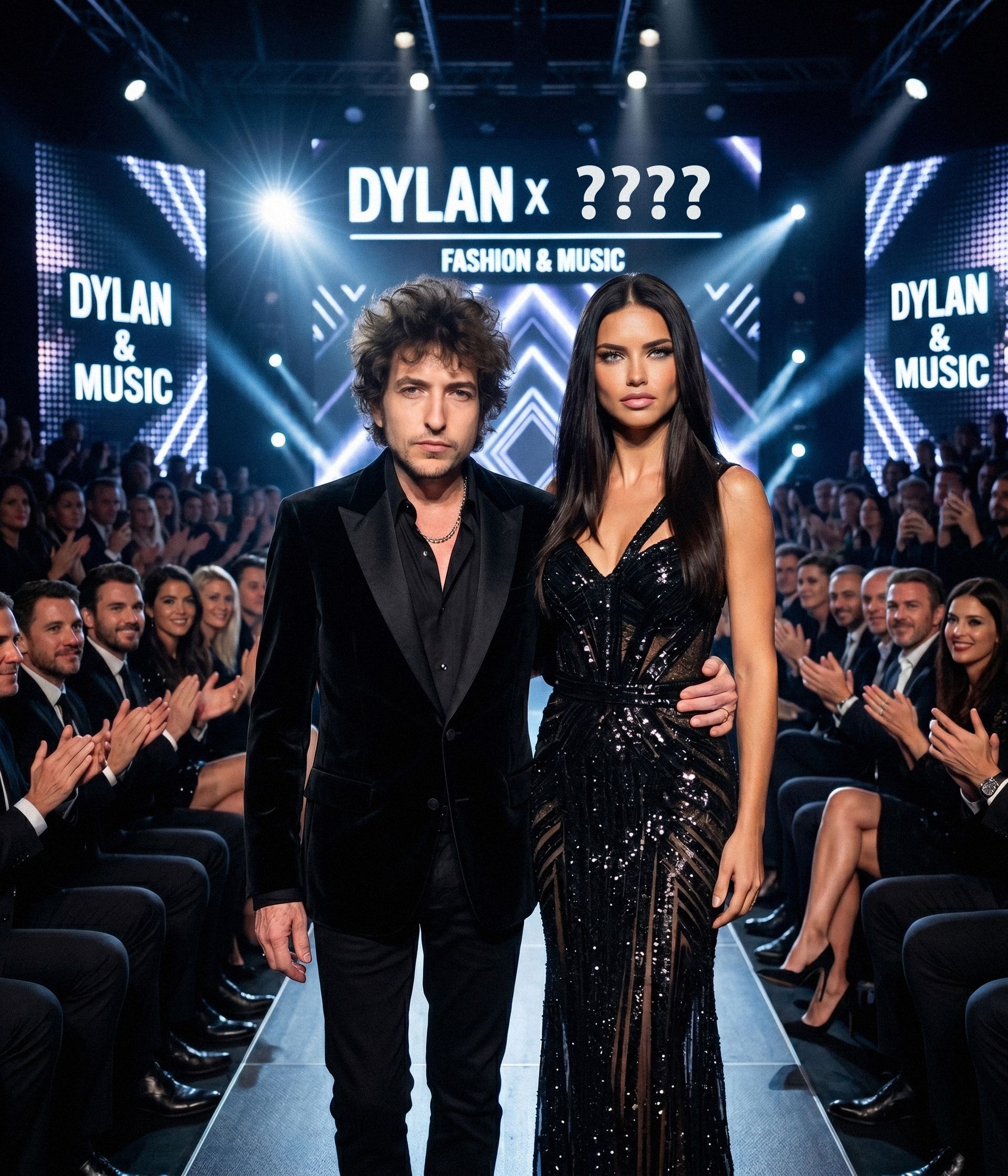
“BOB DYLAN… IN A VICTORIA’S SECRET COMMERCIAL?” — The Surreal TV Moment That Left Fans Speechless
Few artists in modern music history have protected their mystery and independence as fiercely as Bob Dylan. For decades, Dylan cultivated the image of a restless poet, cultural outsider, and deeply private songwriter who rarely followed entertainment industry expectations. That is exactly why audiences were left stunned in 2004 when the legendary folk-rock icon unexpectedly appeared in a glamorous advertising campaign for Victoria’s Secret alongside Brazilian supermodel Adriana Lima.
For many viewers, the commercial felt almost impossible to believe.
The campaign immediately became one of the strangest celebrity collaborations of the decade, combining Dylan’s mysterious artistic image with luxurious fashion photography, cinematic lighting, and emotionally charged visual symbolism. Fans who had spent decades associating Dylan with protest songs, folk music, political poetry, and artistic rebellion suddenly found themselves watching him inside a glossy high-fashion television advertisement.
The reaction was instant confusion.
When the commercial first aired, audiences reportedly struggled to process what they were seeing. Dylan appeared mostly silent throughout the advertisement, standing beneath dim lighting with his trademark cool detachment while Adriana Lima moved through the visually dramatic scenes surrounding him. Meanwhile, Dylan’s own music created a haunting emotional atmosphere that transformed the advertisement into something far stranger than a typical fashion campaign.
The commercial reportedly used Dylan’s song “Love Sick,” whose dark and melancholic tone created a sharp contrast against the glamorous imagery on screen. Rather than feeling cheerful or traditionally romantic, the advertisement carried an eerie emotional tension that many viewers found unexpectedly hypnotic.
Some fans hated it immediately.
Others became fascinated by how bizarrely effective it felt.
For longtime followers of Dylan’s career, the collaboration raised enormous questions. Why would one of the world’s most respected and unpredictable songwriters agree to appear in a luxury fashion advertisement at all? The same artist who once rejected television censorship, avoided celebrity culture, and spent years resisting commercial expectations now appeared in one of the most glamorous advertising campaigns on television.
The contradiction shocked people.
Critics accused Dylan of betraying the anti-commercial spirit many associated with his legacy. Some older fans viewed the campaign as deeply out of character, arguing that Dylan’s mysterious artistic image clashed completely with the world of luxury marketing and fashion advertising.
But supporters defended the decision.
Many argued that Dylan had spent his entire career refusing to let others define what he was “supposed” to do. Again and again, he shocked audiences by abandoning expectations — whether switching from acoustic folk to electric rock, exploring unexpected musical styles, appearing in unusual films, or refusing to behave like a conventional celebrity. To supporters, the Victoria’s Secret campaign represented another example of Dylan doing exactly what he wanted while ignoring public opinion.
And perhaps that unpredictability was precisely what made the commercial unforgettable.
The visual atmosphere reportedly resembled an art-house short film more than a traditional advertisement. Rather than focusing purely on fashion, the campaign leaned heavily into mood, symbolism, mystery, and emotional ambiguity. Dylan barely spoke, yet his presence dominated the screen through silence alone.
That silence became one of the most talked-about elements of the entire project.
Fans described his expressionless appearance as strangely haunting, almost as though he existed outside the glamorous world surrounding him. Instead of looking comfortable or enthusiastic, Dylan appeared emotionally distant and unreadable — qualities that somehow made the commercial even more fascinating.
Then another strange detail emerged.
Reports later revealed that Dylan allegedly accepted the project partly because his daughter admired Adriana Lima and encouraged him to consider the campaign. The surprising behind-the-scenes detail added another layer of curiosity to an already surreal collaboration. For some fans, the revelation humanized Dylan in an unexpected way, showing that even one of music’s most mysterious figures could still be influenced by family conversations behind closed doors.
Others remained skeptical, believing deeper motivations likely existed.
Speculation quickly spread about the financial aspect of the deal as well. By the early 2000s, Dylan had already begun licensing his music for select commercial projects, a move that divided audiences but reflected broader changes occurring across the music industry. Licensing songs for advertising became increasingly common as artists searched for new revenue streams in an evolving entertainment landscape.
Still, nothing quite prepared audiences for the image of Bob Dylan standing inside a Victoria’s Secret commercial.
Looking back today, many fans believe the advertisement succeeded precisely because it felt so unexpected. The strange collision between Dylan’s mysterious artistic legacy and glamorous fashion imagery created an atmosphere viewers simply could not ignore.
More than two decades later, people still revisit the commercial trying to understand exactly what made it so captivating, uncomfortable, surreal, and unforgettable all at once.
And perhaps the real reason the campaign still fascinates audiences is because it revealed something essential about Bob Dylan himself:
No matter how long the world thinks it understands him, he always finds another unexpected way to surprise everyone.