FOR YEARS, PEOPLE CAME FORWARD WITH AN EXTRAORDINARY CLAIM: The Lasting Mystery Behind Elvis Presley’s Alleged Secret Children
Few public figures have inspired as many stories, rumors, and enduring mysteries as Elvis Presley.
Nearly fifty years after his passing, the King of Rock ’n’ Roll continues to capture the imagination of fans across the world. Every year, new books are published, documentaries revisit familiar chapters of his life, and previously unseen photographs or personal memories spark fresh conversations about the man behind the legend.
Yet among all the stories that have followed Elvis through the decades, one question refuses to disappear.
Did Elvis Presley secretly father children the public never knew about?
It is a claim that has surfaced again and again for generations.
From time to time, individuals have stepped into the public eye believing—or claiming—that they were Elvis’s biological son or daughter. Some have pointed to family stories handed down through relatives. Others have highlighted physical similarities, old photographs, personal memories, or circumstances they believe connect them to the King.
Each new claim has generated headlines.
Fans debate the possibility.
Television programs revisit the story.
Social media fills with comparisons and speculation.
For many people, the mystery itself becomes almost as fascinating as Elvis’s extraordinary career.
But when historians separate speculation from documented evidence, a much clearer picture begins to emerge.
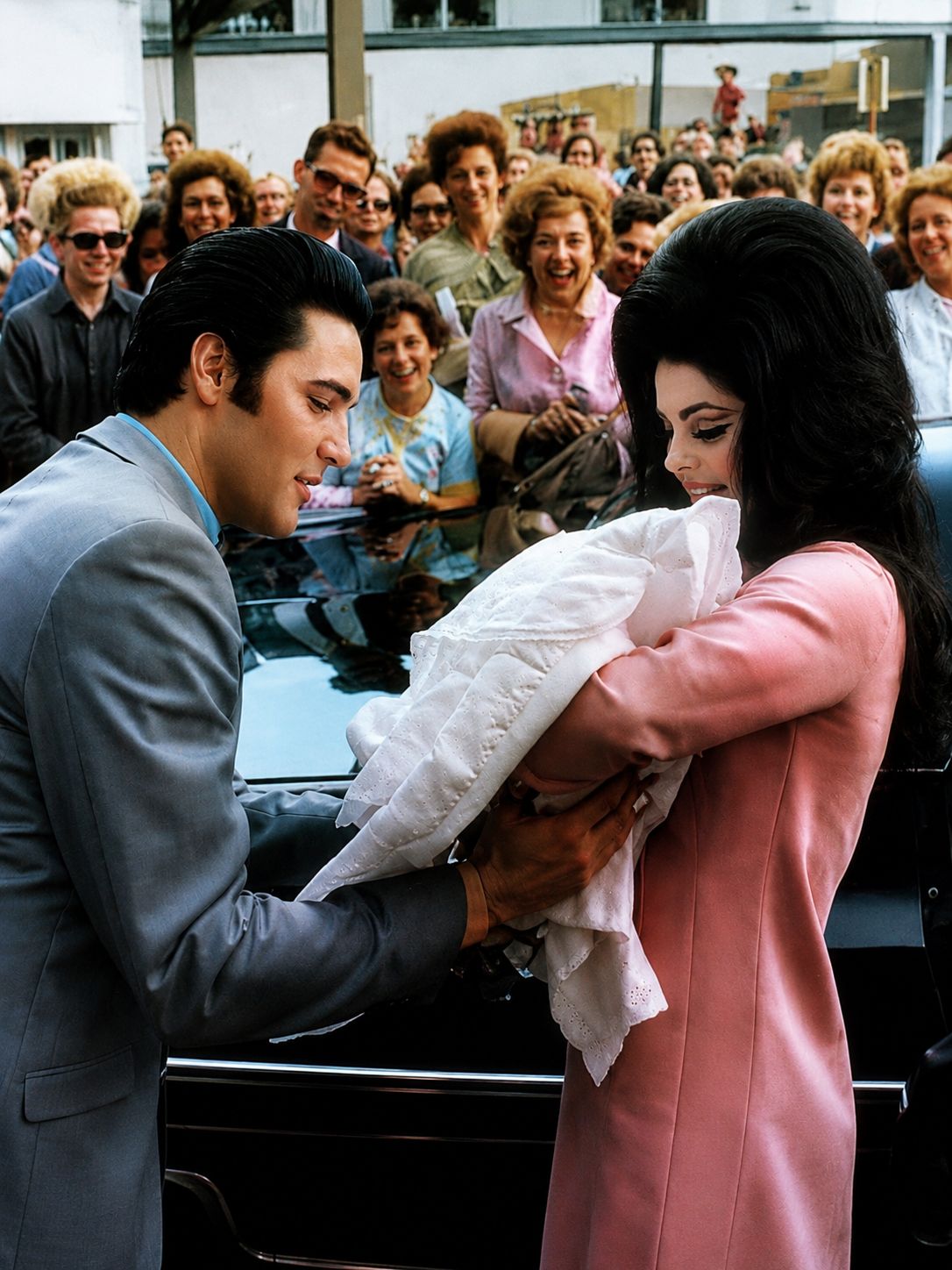
According to the historical record, Elvis Presley had one acknowledged child: Lisa Marie Presley, who was born in 1968 during his marriage to Priscilla Presley.
Throughout Elvis’s lifetime, Lisa Marie was publicly recognized as his only child.
In the decades since his passing, numerous claims about additional children have appeared.
Some people sincerely believe family stories they have heard throughout their lives.
Others have based their conclusions on perceived facial resemblance or personal coincidences.
A few have sought public attention by presenting dramatic narratives.
However, despite the continuing fascination surrounding these stories, none of the widely publicized claims has been conclusively verified through credible historical documentation or broadly accepted evidence.
That distinction is important.
History depends on evidence.
Rumors often depend on possibility.
Those are not the same thing.
Part of the reason these stories continue attracting attention is simple.
Elvis Presley remains one of the most famous entertainers who ever lived.
When someone becomes that influential, almost every aspect of their life eventually becomes surrounded by speculation.
People search for forgotten stories.
Hidden chapters.
Private relationships.
Unexpected family connections.
It is a pattern that has followed many legendary figures throughout history.
The larger the public image becomes, the greater the curiosity about what may have happened away from the spotlight.
For Elvis, that curiosity has never faded.
Visitors from around the world still travel to Graceland hoping to understand not only the performer, but also the man behind the music.
Many discover a story that is already remarkable without adding unverified mysteries.
They learn about the young boy from Tupelo whose love of gospel, country, and rhythm and blues helped reshape popular music.
They discover a performer whose generosity became almost as legendary as his voice.
They see family photographs revealing a devoted father who treasured time with Lisa Marie whenever his demanding schedule allowed.
Those documented moments tell a compelling story all on their own.
Perhaps that is why historians encourage careful thinking whenever sensational claims appear.
A fascinating story is not automatically a factual one.
Extraordinary claims require extraordinary evidence.
Without reliable documentation, responsible history cannot present speculation as established fact.
That approach does not diminish the public’s curiosity.
Instead, it respects both the historical record and the individuals involved.
The confirmed story of Elvis’s family is already rich with love, achievement, triumph, heartbreak, and resilience.
His legacy continued through Lisa Marie, whose own life became deeply intertwined with preserving her father’s memory.
Today, that legacy extends to later generations, including Riley Keough, who has become an important part of the family’s continuing stewardship of the Presley heritage while building a distinguished career of her own.
Perhaps the reason the mystery of Elvis’s alleged secret children continues to fascinate people is not because it has been proven.
It is because legends naturally inspire questions that history cannot always answer to everyone’s satisfaction.
Fans want to know everything about the people they admire.
Sometimes those answers exist.
Sometimes they do not.
In this case, the available historical evidence continues to point in the same direction.
Elvis Presley had one publicly acknowledged child, Lisa Marie Presley.
Claims involving additional children have surfaced repeatedly over the years, but none has been widely accepted as verified by credible historical evidence.
That does not prevent the stories from resurfacing.
Legends rarely escape speculation.
Rumors often outlive the people who inspired them.
But history asks us to draw a careful line between possibility and proof.
Nearly five decades after Elvis Presley left the stage for the final time, the questions continue.
The debates continue.
The fascination continues.
Yet perhaps the most remarkable truth is that Elvis’s real life remains extraordinary enough without the need for hidden heirs or secret family chapters.
His music transformed the world.
His influence reshaped popular culture.
His generosity touched countless lives.
And the family history that is firmly documented continues to inspire millions across generations.
In the end, that may be the greatest lesson behind one of the longest-running Presley mysteries.
Rumors may capture our attention for a moment.
But it is the truth—supported by history, preserved through memory, and carried forward by those who knew and loved him—that continues to define the enduring legacy of Elvis Presley.