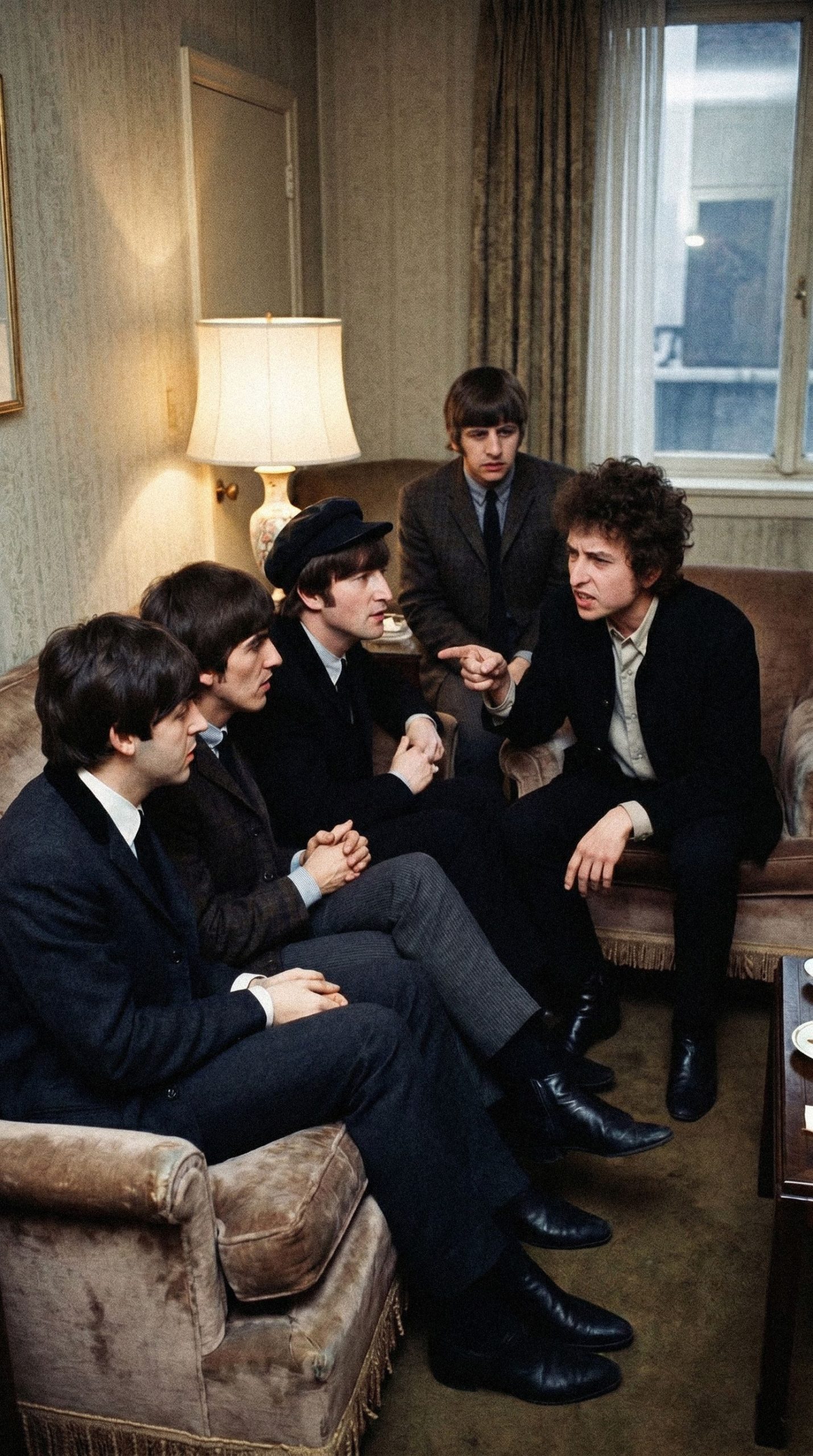
THE HIDDEN RELATIONSHIP BETWEEN DYLAN AND THE BEATLES: Friendship, Rivalry, and the Meeting That Changed Music History
Few relationships in popular music have inspired as much fascination as the connection between Bob Dylan and The Beatles.
Together, they helped redefine what popular music could be during the 1960s. Yet despite their enormous influence on one another, their relationship has often been described as a complicated mixture of admiration, inspiration, and quiet competition.
The story has resurfaced once again following renewed discussion of Dylan’s alleged dismissal of some early Beatles songs as “bubblegum music.”
Whether the remark has been exaggerated over time or not, it reflects a reality that many music historians acknowledge: when Dylan first emerged as a major cultural force, he occupied a very different artistic world from The Beatles.
In the early 1960s, Dylan was celebrated for deeply personal songwriting, social commentary, and folk authenticity. The Beatles, meanwhile, were becoming global superstars through infectious melodies, youthful energy, and songs largely centered on love and relationships.
To some observers, they represented opposite ends of popular music.
But that distinction would not last long.
Everything began to change in 1964.
That year, Dylan and The Beatles famously met for the first time at New York’s Delmonico Hotel. The meeting has since become one of the most legendary encounters in music history.
Stories from that evening have entered rock-and-roll folklore, particularly the widely repeated account that Dylan introduced the band to marijuana. Whether every detail of the story has been accurately remembered is still debated, but there is little doubt that the meeting left a lasting impression on everyone involved.
More importantly, it marked the beginning of a remarkable creative exchange.
Members of The Beatles had already admired Dylan’s songwriting before meeting him. They were fascinated by his ability to write lyrics that explored emotions, identity, and social issues in ways rarely heard in mainstream pop music.
After their encounter, that influence became increasingly visible.
Songs such as You’ve Got to Hide Your Love Away, Norwegian Wood (This Bird Has Flown), and many later compositions revealed a growing interest in introspection and lyrical complexity.
Even John Lennon later acknowledged Dylan’s impact on his writing.
Yet the influence did not flow in only one direction.
Dylan was also paying attention.
The Beatles demonstrated how artistic ambition could coexist with enormous commercial success. Their willingness to experiment in the studio, embrace new sounds, and continually evolve challenged every major artist of the era—including Dylan himself.
As the decade progressed, both sides appeared to push one another creatively.
When Dylan went electric in 1965, he shattered expectations within the folk world. Around the same time, The Beatles were moving beyond conventional pop formulas and creating increasingly sophisticated music.
Each new release seemed to raise the artistic stakes.
Many historians now believe that this unspoken competition helped fuel one of the most extraordinary periods of creativity in modern music history.
Yet describing the relationship as a rivalry alone would be misleading.
Behind the headlines and comparisons, there was genuine mutual respect.
Members of The Beatles repeatedly praised Dylan’s songwriting. Dylan, in turn, expressed admiration for their musical achievements and their ability to connect with audiences on a global scale.
The relationship was perhaps best understood as a conversation between equals—one conducted through records, performances, and artistic risks rather than public declarations.
That conversation helped shape albums that remain among the most influential ever recorded.
Without Dylan’s lyrical innovations, The Beatles might have evolved differently.
Without The Beatles’ relentless experimentation and worldwide impact, Dylan’s own artistic journey might have unfolded in another direction.
The fascinating truth is that neither side can be fully understood without acknowledging the influence of the other.
Today, more than half a century later, fans still debate whether Dylan and The Beatles were friends, rivals, or creative competitors.
The answer may be all three.
They admired one another.
They challenged one another.
And they inspired one another to reach heights that neither might have achieved alone.
That is why the relationship continues to captivate music lovers decades later.
It was not merely a meeting between famous musicians.
It was a collision between two artistic forces that helped transform popular music forever—and whose influence continues to echo through every generation that follows.