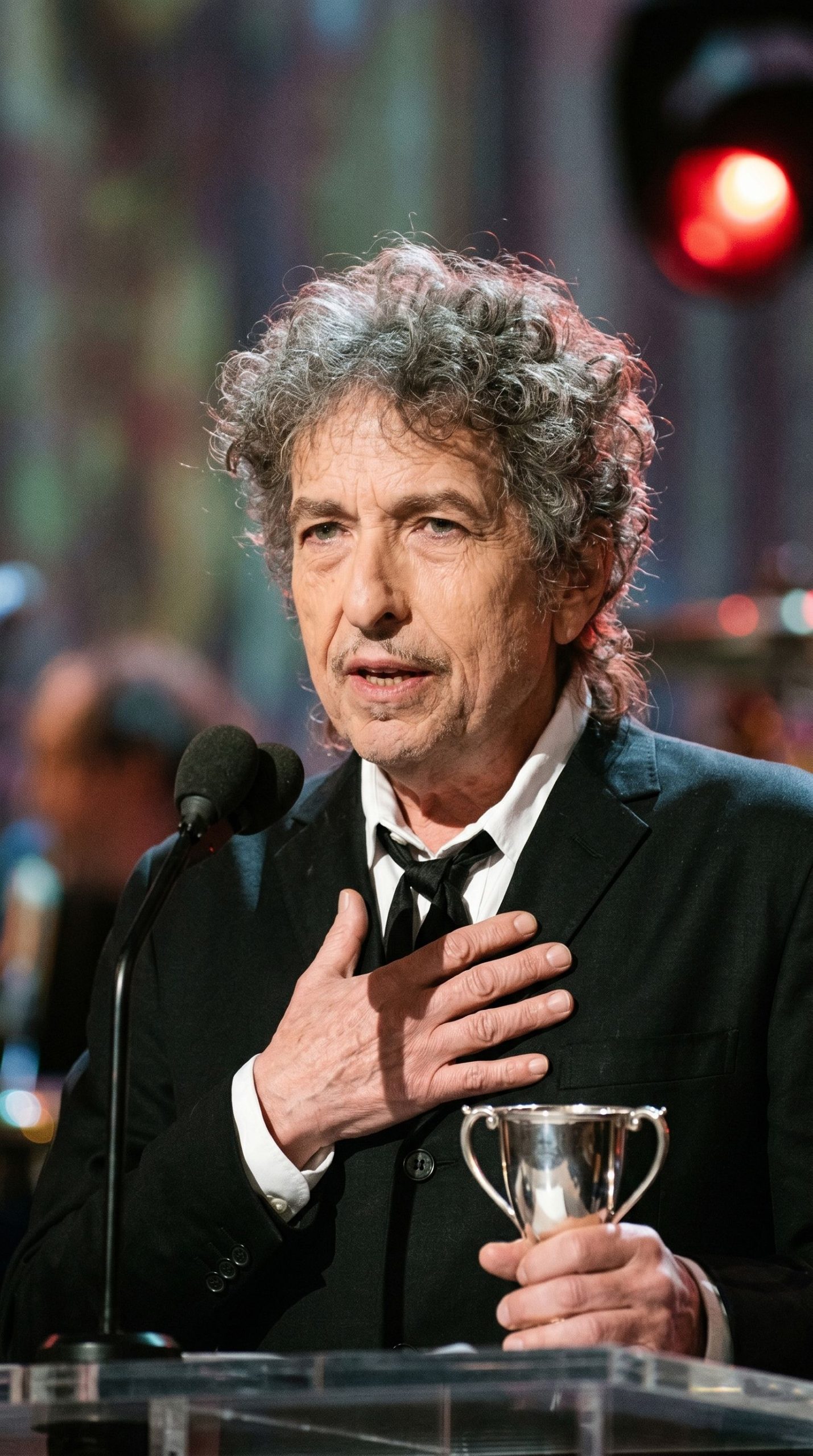
THE HONOR BOB DYLAN WOULDN’T CELEBRATE: Why His Absence From a Prestigious Ceremony Left Fans Wondering
Throughout his extraordinary career, Bob Dylan has received virtually every major honor that the worlds of music, literature, and culture can offer. From Grammy Awards to the Nobel Prize in Literature, the legendary songwriter has accumulated a list of achievements that few artists in history could ever hope to match.
Yet one of the most intriguing moments in Dylan’s relationship with public recognition occurred when he received one of the highest artistic distinctions in the United States—and then quietly chose not to attend the ceremony held in his honor.
The event in question involved Dylan’s election as an honorary member of the prestigious American Academy of Arts and Letters, an organization dedicated to recognizing exceptional achievement in literature, music, architecture, and the visual arts.
For most artists, such an invitation would be considered an extraordinary milestone.
Membership in the Academy has historically been reserved for individuals whose work has had a profound impact on American culture. To be recognized by fellow artists, writers, composers, and intellectuals is often viewed as one of the highest forms of professional respect.
When news emerged that Dylan had been selected for the honor, many observers assumed he would appear at the ceremony to celebrate the occasion.
Instead, fans were surprised to learn that the famously private songwriter would not attend.
The decision immediately sparked curiosity.
Why would someone decline to participate in a ceremony honoring a lifetime of artistic achievement?
Was Dylan making a statement?
Was there a deeper reason behind his absence?
Or was it simply another example of the unpredictable behavior that has followed him throughout his career?
As speculation spread, many longtime followers pointed out that Dylan’s decision was actually consistent with a pattern that stretches back decades.
Unlike many public figures who actively seek recognition, Dylan has often appeared uncomfortable with formal ceremonies and public celebrations focused on his accomplishments.
Throughout his career, he has repeatedly maintained a complicated relationship with awards, honors, and institutional recognition.
This tendency has puzzled observers for years.
On one hand, Dylan clearly appreciates artistic achievement and the importance of creative work. On the other hand, he has frequently seemed reluctant to place himself at the center of public tributes.
Many fans believe the explanation lies in Dylan’s lifelong desire to keep attention focused on the work itself rather than on his personal image.
From the beginning of his career, he resisted becoming a symbol, spokesperson, or cultural monument. Whenever journalists, critics, or fans attempted to define him, Dylan often responded by creating even more mystery.
His absence from the Academy ceremony appeared to fit that pattern perfectly.
According to reports at the time, Dylan cited personal reasons for not attending. While the explanation was brief, it only intensified public fascination. Without additional details, supporters and commentators were left to interpret the decision for themselves.
Some suggested that Dylan simply preferred privacy.
Others believed he may have been focused on touring, recording, or other creative commitments that felt more important to him than public recognition.
Still others argued that Dylan has always viewed artistic honors differently than most people.
For many artists, awards serve as validation.
For Dylan, the creative process itself may have always been the primary reward.
This perspective would hardly be surprising given the way he has lived his life.
Over the course of more than six decades, Dylan consistently placed songwriting, performing, and artistic exploration above celebrity culture. While fame followed him everywhere, he often appeared far more interested in creating new work than celebrating past accomplishments.
That attitude may help explain why he continued touring and recording long after securing his place in history.
To Dylan, the next song often seemed more important than the last award.
The irony, of course, is that his absence may have attracted even more attention than his presence would have.
Had Dylan attended the ceremony, the event likely would have passed as a respected but routine recognition of an already legendary career. By choosing not to appear, he transformed the occasion into yet another chapter in the ongoing mystery surrounding one of America’s most elusive artists.
Fans were left discussing not the award itself, but the man who quietly declined to stand in the spotlight.
In many ways, the episode perfectly captures the paradox of Bob Dylan.
He remains one of the most celebrated figures in modern culture, yet he has spent much of his life avoiding the very attention that accompanies such status.
He accepts honors but rarely seems eager to celebrate them publicly.
He influences generations while refusing to explain himself.
He becomes the center of discussion simply by stepping away from it.
Today, Dylan’s absence from the American Academy of Arts and Letters ceremony remains a fascinating reminder that even after decades of public scrutiny, he continues to operate according to his own instincts rather than anyone else’s expectations.
And perhaps that is precisely why the mystery endures.
While many artists spend their lives seeking recognition, Bob Dylan built a legacy so powerful that he could quietly miss the celebration—and still become the most talked-about person in the room.