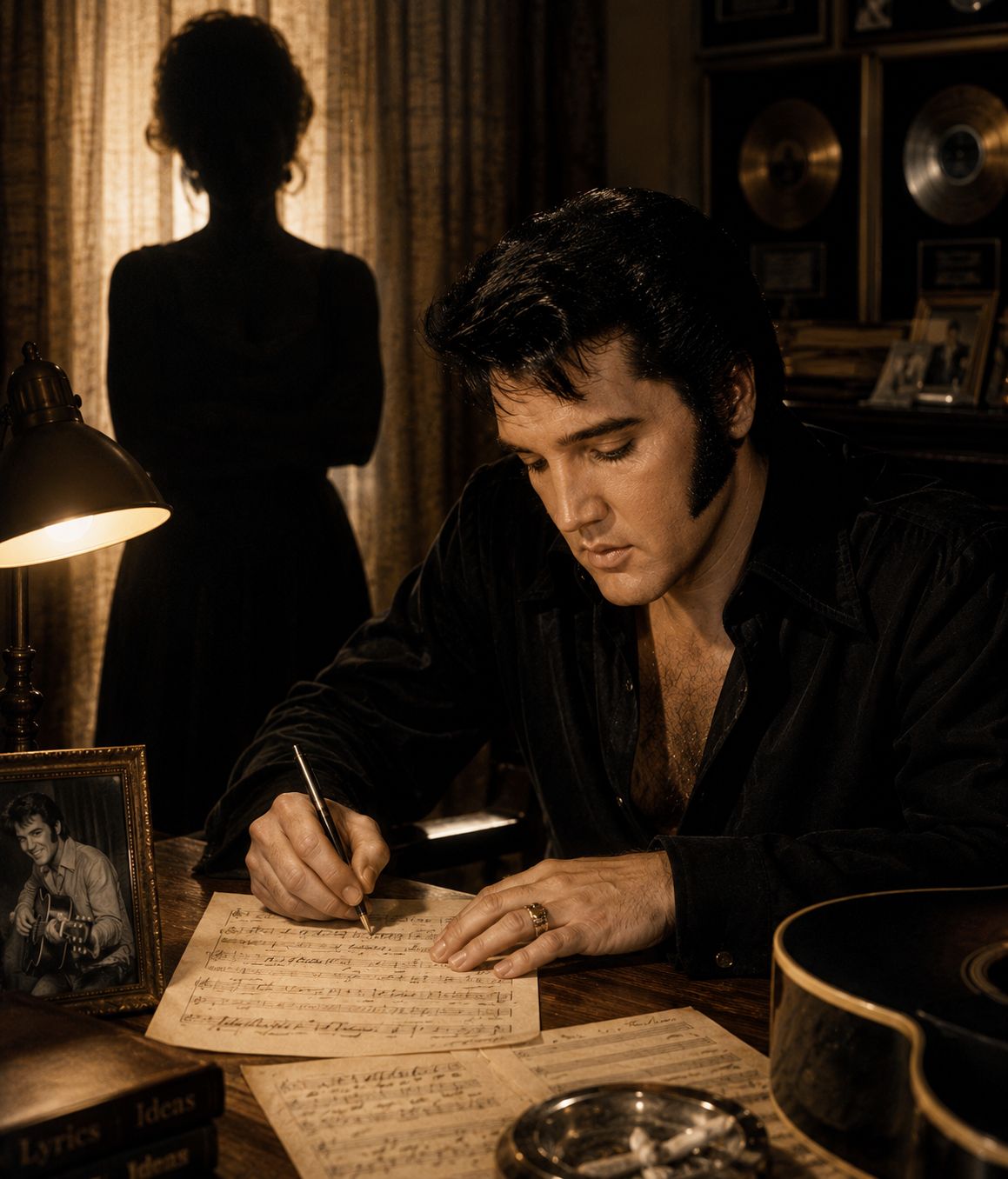
THE PEOPLE WHO SHAPED ELVIS PRESLEY’S GREATEST PERFORMANCES: The Real Story Behind The Emotions That Filled His Most Beloved Songs
When people listen to Elvis Presley, they often hear something that feels deeply personal.
The joy in a rock ’n’ roll anthem.
The tenderness of a love ballad.
The quiet reverence of a gospel hymn.
The heartbreak carried in a single note.
For decades, fans have wondered whether there was one special person behind those unforgettable performances.
The truth is both simpler and far more moving.
Unlike many modern artists, Elvis did not write most of the songs he recorded.
His extraordinary gift was something different.
He could take another songwriter’s words and sing them as though they were drawn from his own life.
That rare ability made listeners believe every emotion they heard.
Behind that gift were several people and experiences that shaped the man long before he became the King of Rock ’n’ Roll.
Perhaps no influence was greater than his mother, Gladys Presley.
From childhood, Elvis shared an exceptionally close bond with her.
She encouraged his love of music, believed in him when success seemed impossible, and remained the emotional center of his world during his early years.
Friends often recalled that the loss of Gladys in 1958 affected Elvis profoundly.
Many biographers have described it as one of the defining emotional moments of his life.
Although no single song can be directly linked to her as its inspiration, many admirers believe the tenderness and vulnerability Elvis brought to emotional ballads reflected the depth of that lifelong bond.
Another enduring influence was his faith.
Growing up in church, Elvis was surrounded by gospel music from an early age.
Those hymns stayed with him throughout his life.
Even after worldwide fame arrived, he regularly returned to gospel recordings—not because they promised commercial success, but because they meant something deeply personal.
Songs such as How Great Thou Art revealed an artist singing not simply as an entertainer, but as someone expressing beliefs that had guided him since childhood.
Love also left its mark on Elvis’s music.
His relationship with Priscilla Presley unfolded during one of the most significant periods of his career.
While the songs themselves were written by professional songwriters rather than specifically about Priscilla, the emotions Elvis brought to many romantic recordings naturally reflected the experiences of a man living through love, marriage, hope, and later heartbreak.
Listeners often connected those performances to chapters of his own life because they felt so genuine.
That sincerity became one of Elvis’s greatest strengths.
He never needed to have written every lyric to make people believe it.
He simply understood human emotion.
He knew what love felt like.
He knew loss.
He knew loneliness.
He knew gratitude.
When he stood before a microphone, those experiences became part of every performance.
Friends who worked with Elvis frequently observed how carefully he chose songs that resonated with him emotionally.
He was not interested only in beautiful melodies.
He wanted songs he could believe.
That instinct explains why recordings such as Can’t Help Falling in Love, Love Me Tender, If I Can Dream, and American Trilogy continue feeling so authentic decades later.
Each performance reflects an artist who understood that music is not merely heard.
It is felt.
There was another influence that shaped Elvis throughout his life.
The people who listened.
He often spoke about the importance of his audience and the responsibility he felt each time he stepped onto a stage.
Whether performing for a few hundred people early in his career or thousands in sold-out arenas, Elvis approached every concert with the same goal—to create a genuine connection.
That relationship with his fans became one of the defining inspirations of his career.
Visitors who walk through Graceland often discover that the story of Elvis is not centered on a single muse or one dramatic romance.
Instead, it is the story of a man shaped by family, faith, love, friendship, and the experiences that accompany an extraordinary life.
Those influences cannot always be traced to one particular song.
They can, however, be heard in the way he sang.
Perhaps that is why Elvis’s greatest recordings continue moving listeners nearly half a century after his passing.
People do not remember them simply because of unforgettable melodies.
They remember them because the emotions feel real.
Behind every performance stood a man whose life had been shaped by those he loved, the faith that sustained him, and the experiences that taught him both joy and sorrow.
In the end, the greatest inspiration behind Elvis Presley’s music was not one mysterious individual hidden from history.
It was the life he lived.
A life filled with love, loss, hope, gratitude, and unwavering passion for music.
And every time his voice begins to play, those experiences continue speaking to new generations—reminding the world that the most powerful performances are often inspired not by a single person, but by the journey of the heart itself.