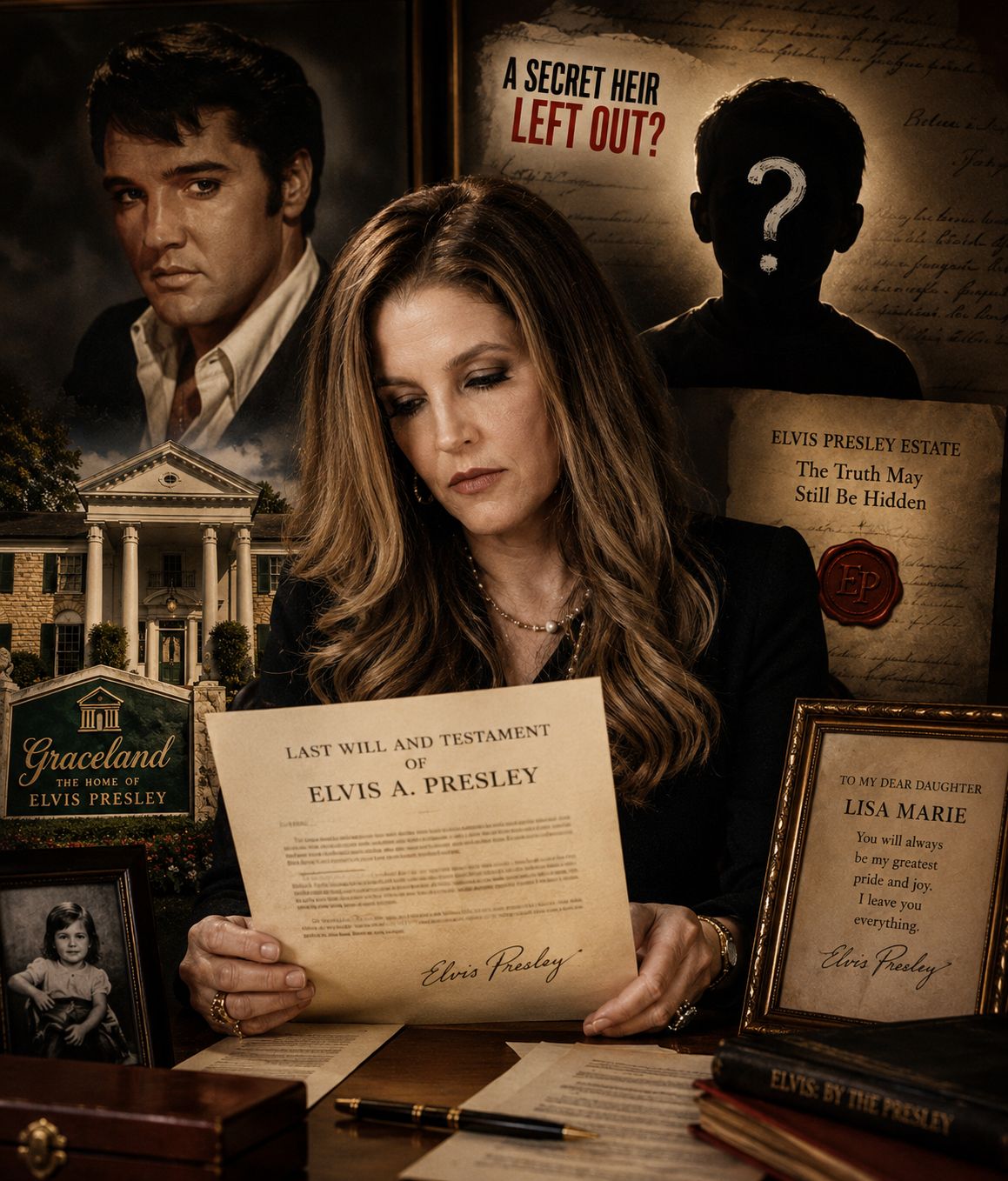
THE MYSTERY SURROUNDING ELVIS’S WILL: Why Rumors About Hidden Heirs Have Never Stopped Following The King Of Rock ’n’ Roll
When Elvis Presley passed away on August 16, 1977, he left behind far more than a remarkable catalog of music.
He left behind one of the most valuable and closely watched legacies in entertainment history.
His home.
His recordings.
His personal belongings.
His image.
His influence on popular culture.
And, naturally, the question that often follows every legendary figure:
Who inherited it all?
For nearly five decades, that question has inspired countless books, television programs, magazine articles, documentaries, and online discussions.
Alongside the documented history, another story gradually emerged.
Rumors.
Claims of secret heirs.
Stories about hidden beneficiaries.
Speculation that Elvis’s will contained mysteries the public had never discovered.
The theories have resurfaced generation after generation.
Yet when historians examine the historical record, the reality proves both clearer and, in many ways, just as compelling.
Elvis prepared a formal will in 1977.
The document identified the principal beneficiaries of his estate and established a trust to manage those assets.
His father, Vernon Presley, served as executor of the estate, while the trust was created for the benefit of family members, with his only child, Lisa Marie Presley, becoming the primary beneficiary.
The trust was structured so that Lisa Marie would receive control upon reaching adulthood.
Following Elvis’s death, Vernon Presley managed the estate during a period of enormous public attention.
When Vernon died in 1979, responsibility shifted in accordance with the trust arrangements, with trusted representatives—including Priscilla Presley in a significant management role during Lisa Marie’s minority—helping oversee the preservation and future of the estate.
Those decisions would ultimately help transform Graceland into one of America’s most visited historic homes and protect Elvis’s legacy for future generations.
Those are the documented facts.
So why have rumors continued for so many years?
Part of the answer lies in Elvis himself.
Few public figures have inspired as much fascination.
Every aspect of his life has been examined.
His friendships.
His relationships.
His career.
His final years.
When someone becomes as iconic as Elvis Presley, curiosity naturally extends beyond the stage and into every corner of their personal life.
Stories that might never gain attention if attached to an ordinary family can quickly spread when connected to a global legend.
Among the most persistent rumors are claims that Elvis secretly included unknown heirs in his will or quietly left portions of his fortune to children whose identities were hidden from the public.
Over the years, individuals have occasionally claimed to be Elvis’s biological children or suggested they were entitled to part of the estate.
Those stories often generate headlines because they involve one of the world’s most recognizable names.
However, despite decades of speculation, no credible historical evidence has established the existence of secret heirs or undisclosed beneficiaries recognized under Elvis’s will.
The documented estate records tell a consistent story.
History, however, is rarely as exciting as rumor.
Mysteries attract attention.
Facts often receive far less publicity.
That is why many myths continue resurfacing, even after they have been repeatedly examined.
Ironically, the real story behind Elvis’s estate is already extraordinary.
At the time of his passing, financial challenges meant the estate was far less valuable than many people assumed.
Yet through careful stewardship, thoughtful management, and the enduring popularity of Elvis’s music, the Presley estate experienced one of the most remarkable turnarounds in entertainment history.
Graceland became an internationally recognized destination.
His recordings continued reaching new audiences.
Licensing, exhibitions, and renewed interest introduced Elvis to generations that had never seen him perform live.
The result was a legacy that grew stronger with time.
That achievement owes much to the dedication of those entrusted with preserving it.
Today, following Lisa Marie Presley’s passing, her daughter Riley Keough has taken on an important role in the continuing stewardship of the family’s interests, ensuring that one of music’s greatest legacies continues into another generation.
Perhaps that ongoing commitment explains why the myths have never completely disappeared.
People often assume there must be another hidden chapter.
Another forgotten document.
Another secret waiting to be discovered.
But sometimes the documented story is the most remarkable one.
A young man from Tupelo changed the course of popular music.
He left his estate to those closest to him through a legally established trust.
His family spent decades protecting his memory.
And nearly fifty years later, his legacy continues inspiring millions around the world.
That truth requires no embellishment.
No hidden heirs.
No secret beneficiaries.
No mysterious final surprise.
It is already one of the most extraordinary stories in American music history.
Perhaps that is the real reason questions about Elvis’s will continue to return.
Not because the historical record is incomplete.
But because legends naturally inspire people to wonder if there is one more chapter waiting to be discovered.
In Elvis Presley’s case, the greatest mystery was never who inherited his estate.
It was how one man’s music could become such an enduring gift that, decades later, it still belongs—emotionally—to millions of people across the world.
That is a legacy no will could ever fully contain.