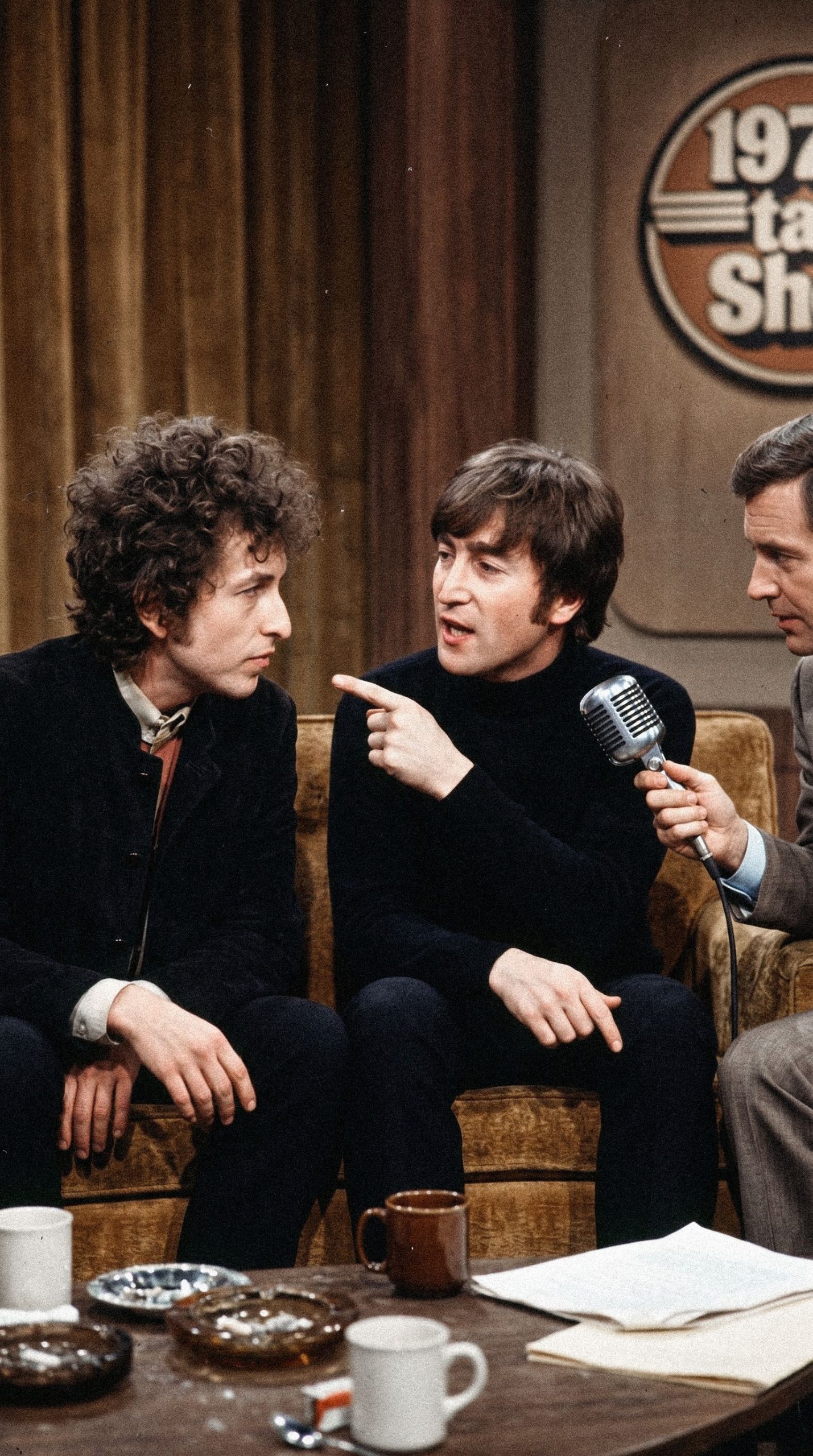
“BECAUSE DYLAN IS BULLSHIT” — Why John Lennon’s Brutal Comment About Bob Dylan Still Shocks Music Fans Today
Decades after both men transformed modern music forever, the complicated relationship between John Lennon and Bob Dylan continues fascinating fans across the world.
Now, an old and startlingly blunt interview connected to Lennon has resurfaced online once again, reigniting debate about what may have truly existed beneath the surface between two of the most influential songwriters of the twentieth century.
The comment that shocked fans most reportedly came during a conversation with Rolling Stone, when Lennon said:
“Because Dylan is bullshit. You see, I don’t believe in Dylan, and I don’t believe in Tom Jones either, in that way.”
For longtime admirers of both artists, the statement felt surprisingly harsh — especially considering the enormous mutual influence that once existed between Dylan and The Beatles during the 1960s.
After all, Dylan famously inspired The Beatles to pursue more introspective and lyrically ambitious songwriting. Meanwhile, The Beatles helped push Dylan toward electric rock experimentation that permanently changed popular music history.
On the surface, the relationship looked historically important and creatively respectful.
Yet underneath that admiration, many historians and fans believe there were also layers of tension, insecurity, rivalry, and philosophical disagreement that complicated the connection over time.
Part of the issue may have involved authenticity.
During the 1960s, both Lennon and Dylan became symbolic figures far larger than ordinary musicians. Critics and audiences projected enormous cultural meaning onto them. Dylan became associated with protest movements, poetic seriousness, and political symbolism, while Lennon increasingly emerged as a rebellious public intellectual challenging social norms and political power structures.
The pressure surrounding those identities became overwhelming.
Some observers believe Lennon eventually grew skeptical of the almost mythological status surrounding Dylan — particularly the way critics often treated Dylan as a mysterious prophet-like figure rather than simply a songwriter. Lennon himself frequently struggled with public expectations and media mythology, and he sometimes reacted aggressively toward artists he felt were being romanticized excessively.
In that context, the comment about Dylan may have reflected frustration not only with Dylan personally, but with the larger cultural obsession surrounding him.
Lennon often admired honesty and emotional directness, even when expressed harshly. Throughout his life, he repeatedly attacked what he saw as pretension, artificial image-making, or intellectual performance within the music world. Some fans now believe Lennon viewed parts of Dylan’s public persona as intentionally mysterious in ways he personally distrusted.
Ironically, Lennon himself would later become trapped inside his own mythology as well.
There may also have been creative jealousy involved.
Although Dylan and Lennon operated in different musical spaces, both were constantly compared as generational voices capable of expressing political unrest, emotional alienation, and cultural transformation through songwriting. Critics endlessly debated which artist possessed greater lyrical depth or cultural significance.
Such comparisons naturally created pressure.
For Lennon especially, Dylan represented a songwriter critics often described in almost literary or spiritual terms — praise that sometimes overshadowed other musicians of the era, including members of The Beatles themselves. Some insiders long suspected Lennon felt conflicted admiration toward Dylan: deeply influenced by him artistically, yet also irritated by the near-religious seriousness with which parts of the media treated him.
At the same time, the relationship between the two men was never purely hostile.
In fact, Lennon openly acknowledged Dylan’s influence on his songwriting multiple times over the years. During the mid-1960s, Dylan’s emotionally personal lyrical style strongly affected Lennon’s approach to music, helping inspire more introspective Beatles songs that moved beyond traditional pop themes.
The artistic influence was undeniable.
That complexity is partly why Lennon’s harsh comments still fascinate fans today.
Because the relationship appears filled with contradiction:
Admiration mixed with skepticism.
Influence mixed with rivalry.
Respect mixed with emotional irritation.
Some music historians also point out that Lennon’s interviews were famously unpredictable and emotionally volatile. He often spoke impulsively, contradicted himself publicly, or made brutally exaggerated remarks depending on his mood at the time. Statements that sounded deeply personal one year might completely conflict with comments he made elsewhere.
That unpredictability makes interpreting the Dylan criticism difficult.
Was Lennon expressing genuine resentment?
Momentary frustration?
Intellectual skepticism?
Or simply reacting emotionally during a candid conversation?
Perhaps the answer involves all of those things at once.
What remains undeniable is that both Lennon and Dylan carried enormous psychological pressure throughout their careers because of the impossible expectations placed upon them. Each man became trapped inside symbolic identities created partly by fans, critics, politics, and media mythology.
Both were expected to represent entire generations emotionally and culturally.
And both spent much of their lives resisting those labels while simultaneously benefiting from them.
In some ways, Lennon may have recognized uncomfortable similarities between himself and Dylan — two fiercely intelligent artists struggling against the burden of public symbolism while being worshipped by millions of people searching for meaning inside their music.
That recognition may have created admiration.
But perhaps it also created tension.
Today, decades after their most controversial comments and artistic battles, fans increasingly view the relationship between John Lennon and Bob Dylan not as a simple feud, but as something far more human and emotionally complicated.
Two revolutionary artists.
Two enormous egos.
Two cultural icons carrying impossible expectations.
And beneath it all, two men perhaps trying to understand each other while secretly struggling to understand themselves at the very same time.