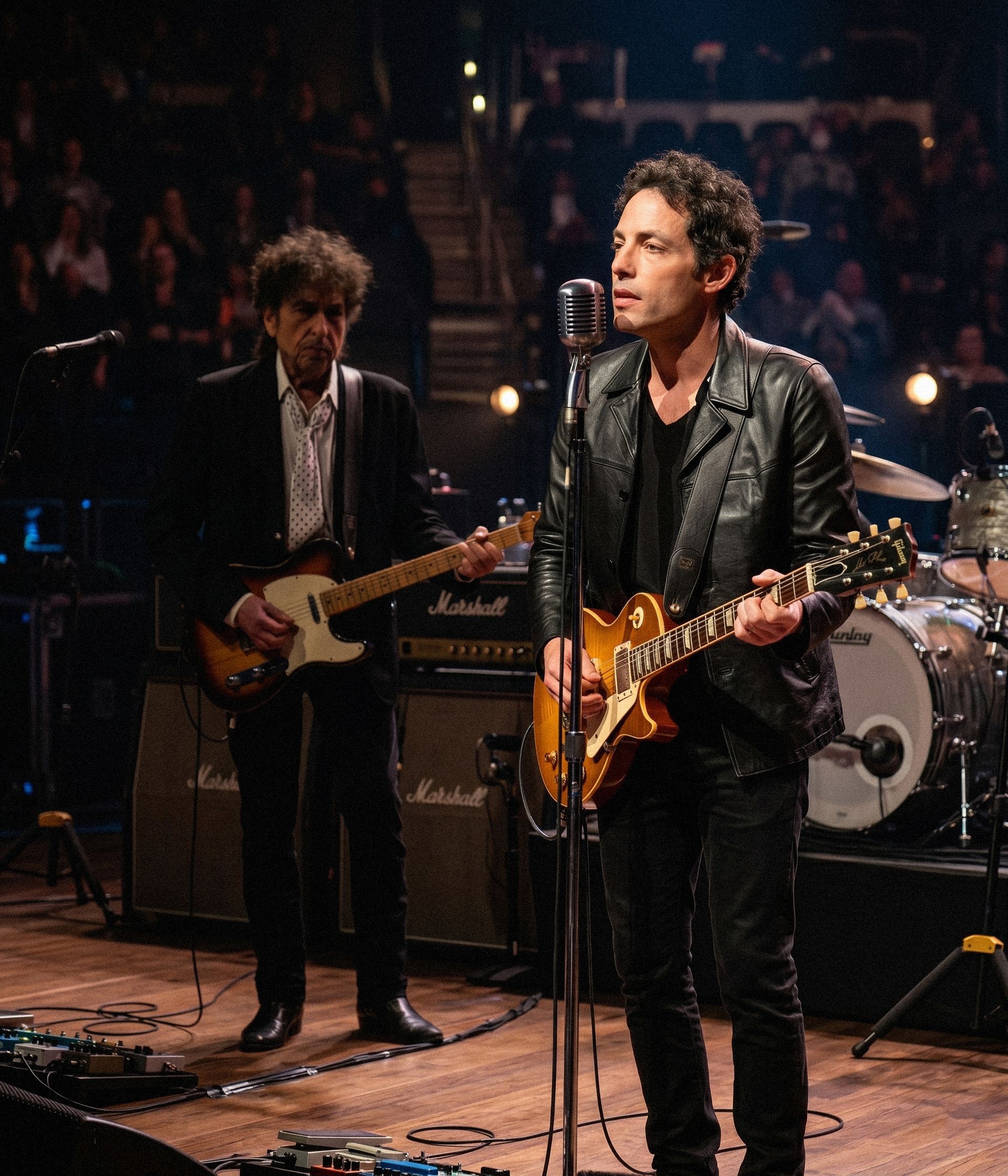
“CAN ANYONE ESCAPE THE DYLAN SHADOW?” — The Quiet Struggle Behind Jakob Dylan’s Musical Identity
Being the son of Bob Dylan may sound like a dream to music fans around the world. But for Jakob Dylan, carrying one of the most legendary surnames in modern music history also came with enormous pressure, constant comparisons, and expectations almost impossible to escape.
For decades, fans and journalists repeatedly asked the same question:
Would Jakob Dylan continue his father’s musical legacy — or spend his entire life trying to avoid becoming a copy of Bob Dylan?
That tension followed Jakob from the very beginning of his career.
As the frontman of The Wallflowers, Jakob emerged during the 1990s with a sound and artistic identity very different from the folk-poetry style that transformed his father into a cultural icon. Rather than directly imitating Bob Dylan’s protest-era songwriting or acoustic folk image, Jakob leaned toward alternative rock, emotionally restrained lyrics, and a more contemporary band-driven sound.
Yet no matter what direction he chose, comparisons proved unavoidable.
Critics analyzed his voice, his writing style, his stage presence, and even his facial expressions searching for traces of his father. Interviews often focused less on Jakob himself and more on the enormous shadow surrounding the Dylan name. Supporters admired his talent, while skeptics constantly questioned whether audiences would have paid attention at all if his last name had been different.
Over time, Jakob appeared increasingly determined to establish his own identity separate from the mythology surrounding Bob Dylan.
Unlike his father’s famously mysterious and unpredictable personality, Jakob developed a calmer, more grounded public image. He rarely embraced grand political symbolism or cultural mystique in the same way Bob Dylan often did during the height of the 1960s counterculture era. Instead, Jakob focused heavily on songwriting craft, band chemistry, and emotional honesty within modern rock music.
That independence became especially clear through albums like Bringing Down the Horse, which helped transform The Wallflowers into one of the most successful rock bands of the late 1990s. Songs such as “One Headlight” proved Jakob could connect with audiences on his own terms rather than simply repeating the past.
Still, the burden of expectation never completely disappeared.
Fans remained fascinated by the relationship between father and son partly because Bob Dylan himself represented such a towering figure in music history. Few artists carried greater cultural weight or artistic influence. The idea of growing up under that kind of legacy naturally sparked endless curiosity about whether Jakob felt pressure to continue, reject, or reinvent the Dylan musical tradition.
Interestingly, Jakob often spoke respectfully but honestly about those expectations in interviews over the years.
Rather than attempting to imitate his father directly, he frequently emphasized the importance of authenticity and individuality. Observers noted that Jakob appeared less interested in becoming “the next Bob Dylan” than in avoiding becoming trapped by that comparison entirely.
Some fans interpreted that attitude as quiet rebellion.
Others saw it as survival.
Because perhaps the greatest challenge facing children of legendary artists is not competing with their parents’ success — but preserving enough personal identity to create something emotionally genuine under the weight of impossible expectations.
In many ways, Jakob Dylan’s career became a long negotiation between inheritance and independence.
The Dylan name undoubtedly opened doors and attracted attention, but it also created scrutiny few musicians ever experience. Every artistic decision risked comparison to one of the most respected songwriters in history. Too much similarity invited accusations of imitation. Too much difference invited criticism for abandoning the family legacy.
There was no easy path.
Yet over time, many fans came to respect the fact that Jakob refused to simply recreate his father’s image for commercial comfort. Instead, he slowly built a career shaped by his own influences, generation, and musical instincts.
And perhaps that is the most fascinating part of the story.
Not a dramatic family feud or secret conflict behind closed doors — but the quieter, more human struggle of a son attempting to discover who he truly was while carrying one of the heaviest names in music history.
Today, many listeners believe Jakob Dylan ultimately succeeded precisely because he never tried to become another Bob Dylan.
He became himself.
And in the shadow of a legend that enormous, that may have been the hardest achievement of all.